
Order of Operations on a Calculator: PEMDAS and BEDMAS Explained
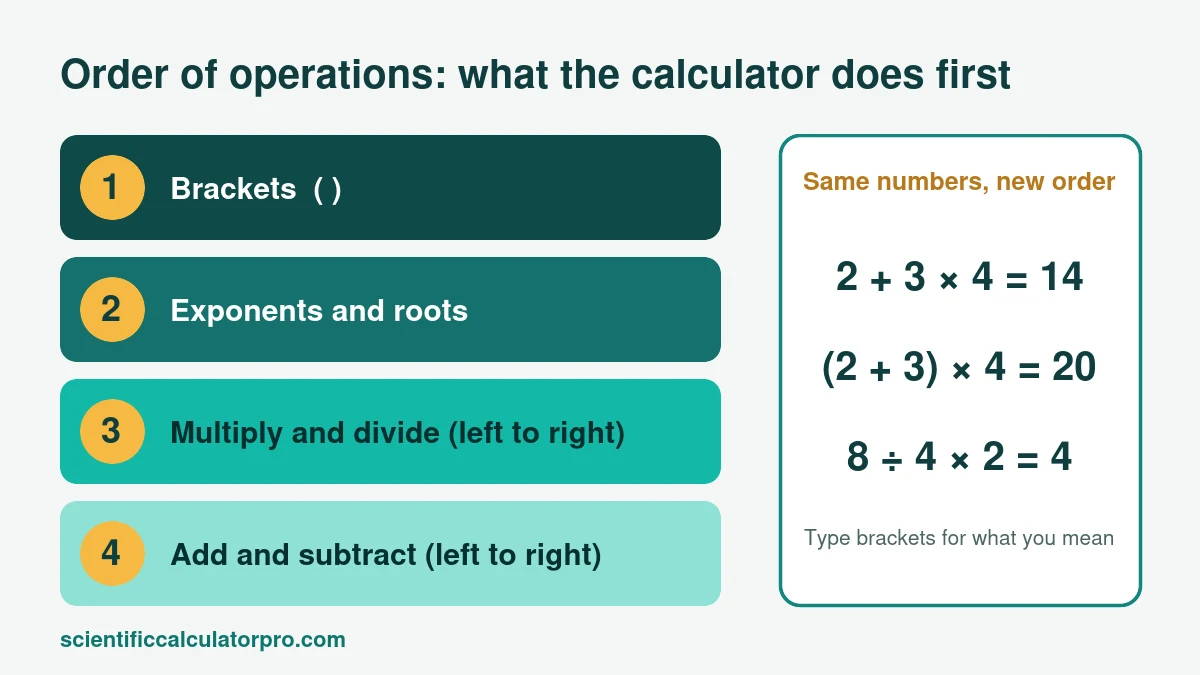
The order of operations on a calculator is the standard one: brackets first, then exponents, then multiplication and division from left to right, then addition and subtraction from left to right. So 2 + 3 × 4 = 14, not 20. To get 20, type the brackets yourself: (2 + 3) × 4.
Most wrong answers on a calculator are not calculator faults. They come from a missing bracket, a minus sign in the wrong place, or an expectation that the machine reads left to right. Learn the four traps below and you will stop losing marks to them.
Do You Need Parentheses for Order of Operations on a Scientific Calculator?
Yes. The order of operations on a calculator is fixed, so whenever you want something to happen first you must use brackets. The usual cases are the top and bottom of a fraction, a negative number with an exponent, and anything that comes after a division sign. When in doubt, add brackets. An extra pair never changes the answer, and a missing pair often does.
| What you mean | What to type | Result | What goes wrong without brackets |
|---|---|---|---|
| (5 + 7) over (2 + 4) | (5+7)÷(2+4) | 2 | 5+7÷2+4 gives 12.5 |
| 1 divided by (2 × 3) | 1÷(2×3) | 0.1667 | 1÷2×3 gives 1.5 |
| Negative 2, squared | (−2)^2 | 4 | −2^2 gives −4 |
| Sine of (30 + 5) degrees | sin(30+5) | 0.5736 | sin(30)+5 gives 5.5 |
What Do PEMDAS, BEDMAS and BODMAS Mean?
They are three memory aids for the same order of operations on a calculator and on paper. The letters change by country, but the order does not.
| Acronym | Used in | Stands for |
|---|---|---|
| PEMDAS | USA | Parentheses, Exponents, Multiplication, Division, Addition, Subtraction |
| BEDMAS | Canada | Brackets, Exponents, Division, Multiplication, Addition, Subtraction |
| BODMAS | South Africa, UK, India | Brackets, Of (orders), Division, Multiplication, Addition, Subtraction |
In Brazil the same rule is taught without an acronym: parentheses, brackets and braces first, then powers and roots, then multiplication and division, then addition and subtraction.
The letters hide one trap. Multiplication and division share a single level, and so do addition and subtraction. The acronym lists them one after the other, but you never do all the multiplication before all the division.
Which Comes First, Multiplication or Division?
Neither. They have equal rank, so you work from left to right, on paper and in the order of operations on a calculator. That means 8 ÷ 4 × 2 = 4, because 8 ÷ 4 = 2 and then 2 × 2 = 4. If you did the multiplication first you would get 1, which is wrong.
The same goes for addition and subtraction. 10 − 3 + 2 = 9, because 10 − 3 = 7 and then 7 + 2 = 9. Doing the addition first gives 5, which is wrong.
Why Does My Calculator Give a Different Answer Than PEMDAS Suggests?
Usually because the order of operations on a calculator followed PEMDAS exactly, and the person worked it out in a different order. A question that keeps coming back online is 5 − 9 ÷ 8.085 + 29 ÷ 72. Some people expect 3.4840 and the calculator shows 4.2896. The calculator is right. Here are the steps:
- Division first: 9 ÷ 8.085 = 1.1132 and 29 ÷ 72 = 0.4028
- Then left to right: 5 − 1.1132 = 3.8868, and 3.8868 + 0.4028 = 4.2896
The other common cause is implied multiplication. In 6 ÷ 2(1 + 2), going strictly left to right gives 9. Some calculators treat 2(1 + 2) as one tight block and return 1. Makers do not agree on this, so type the multiplication sign yourself: 6÷2×(1+2) is 9, and 6÷(2×(1+2)) is 1.
How Does a Calculator Handle Exponents and Negative Numbers?
In the order of operations on a calculator, exponents come before multiplication, so −2^2 is read as the negative of 2 squared, which is −4. If you want 4, type (−2)^2. A few older models treat the minus as part of the number and return 4 for −2^2, so test your own model once.
Stacked powers need care too. 2^3^2 means 2 to the power of 3^2, which is 2^9 = 512. Excel works it from left to right and returns 64. If you build the same formula in a spreadsheet, add the brackets you mean.
Do Trig and Log Keys Need Brackets?
Yes. Trigonometric functions and logarithmic functions both need a closing bracket after the number. sin(30)+5 is 5.5 in degree mode, but sin(30+5) is 0.5736. Both are valid, and they mean different things. Check that the calculator is in the right angle mode too, which our beginner’s guide shows step by step.
Try These Five Problems
Work each one by hand first, then check the order of operations on a calculator. Answers are at the end of the list.
- 12 − 4 × 2
- (12 − 4) × 2
- 18 ÷ 3 × 2
- 3 + 2^3 × 2
- 20 − (6 + 4) ÷ 2
Answers: 1) 4, 2) 16, 3) 12, 4) 19, 5) 15. If you got problem 3 wrong, you probably did the multiplication before the division.
Can You Check Your Work Without Starting Over?
Yes. Use the arrow keys to move back through the line and fix one number, or open the history list to reuse an earlier result. You can test any example from this page on our free online calculator, which keeps a history panel so you can compare your own steps with the result.
More Guides
- How to Calculate MOD (Remainder) on a Calculator
- A Beginner’s Guide to Using Your Calculator
- How to Find a Square Root Without a Calculator
- The Real Benefits of Using a Calculator in School
- Browse all guides
Sources
Checked October 2026. Every worked example was calculated by hand and verified.