How to Find a Square Root Without a Calculator
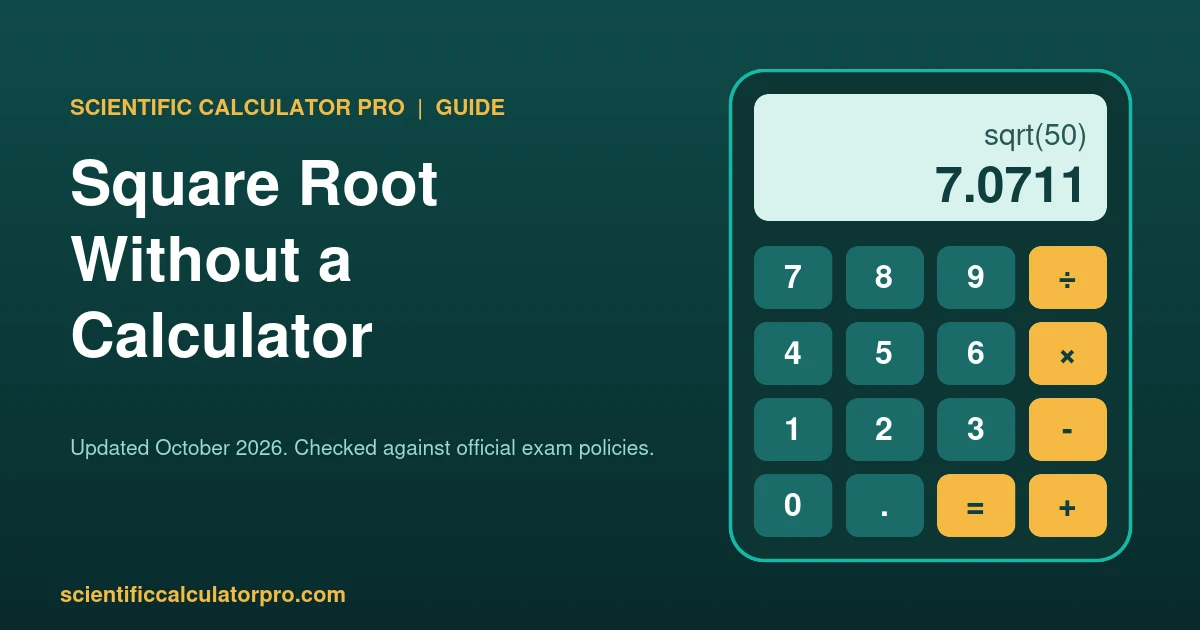
To find a square root without a calculator, locate the two perfect squares your number sits between, guess a decimal, then square your guess and adjust. For √50, 7² = 49 and 8² = 64, so the answer is just above 7. A guess of 7.07 gives 7.07² = 49.98, which is already very close. Below are four methods, from a quick estimate to a near-exact answer.
You need this skill in more places than you might expect. Part of the AP Calculus exam is calculator-free, ENEM in Brazil allows no personal calculator, and estimating a root in your head is the fastest way to catch a typing mistake on any exam.
How Do You Find a Square Root Without a Calculator?
Start by memorising the perfect squares. Every square root without a calculator starts from them, so knowing them cold saves time on every method below.
| Number | Square | Number | Square |
|---|---|---|---|
| 12 | 144 | 17 | 289 |
| 13 | 169 | 18 | 324 |
| 14 | 196 | 19 | 361 |
| 15 | 225 | 20 | 400 |
| 16 | 256 | 25 | 625 |
If your number is on the list, the root is a whole number. If it is not, it sits between two whole numbers, and the next methods tighten the gap.
What Is the Fastest Way to Estimate a Square Root?
For a quick square root without a calculator, pick the nearest perfect square, call its root a, and use this shortcut: root ≈ a + (number − a²) ÷ (2a). It takes one line and is usually right to two or three decimals.
- √50: a = 7, so 7 + (50 − 49) ÷ 14 = 7.0714. The true value is 7.0711.
- √200: a = 14, so 14 + (200 − 196) ÷ 28 = 14.1429. The true value is 14.1421.
The shortcut is a little less accurate for numbers far from a perfect square, so switch to the next method when you need more digits.
How Does the Babylonian Method Work?
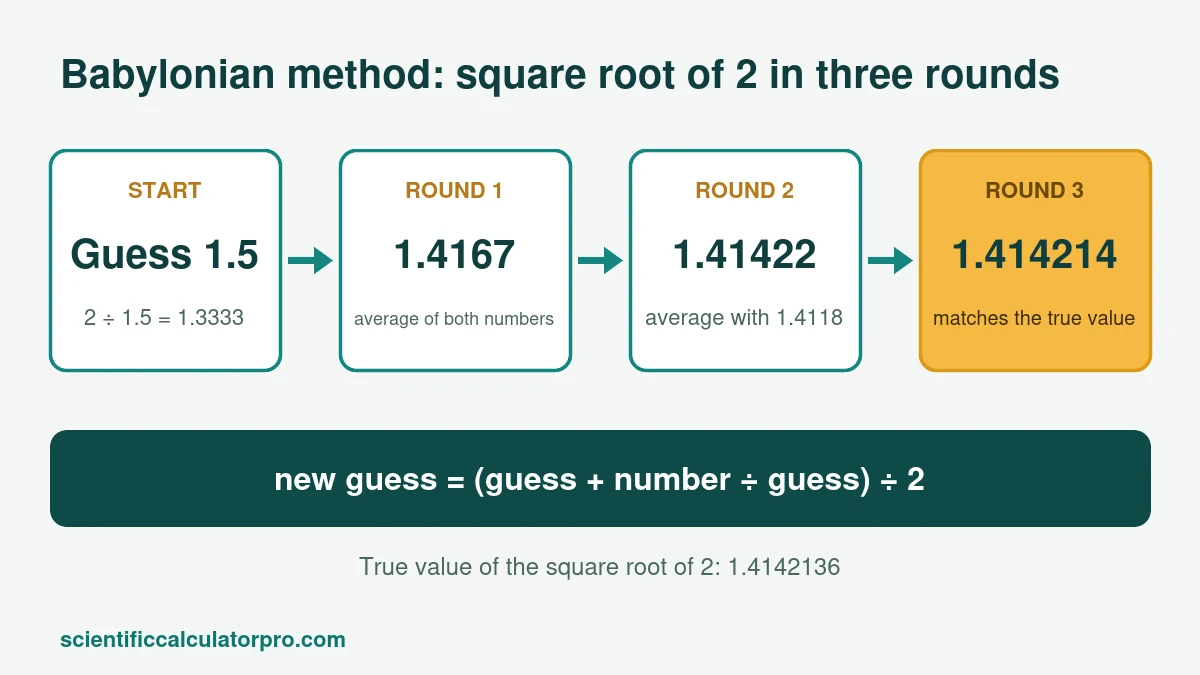
It is a guess-and-improve loop, and it gives a square root without a calculator in three or four rounds. Make a guess, divide your number by the guess, then average the two. The average becomes your next guess. Repeat until the digits stop changing. The formula is new guess = (guess + number ÷ guess) ÷ 2.
Take √2 with a starting guess of 1.5:
| Step | Guess | Number ÷ guess | New guess |
|---|---|---|---|
| 1 | 1.5 | 1.3333 | 1.4167 |
| 2 | 1.4167 | 1.4118 | 1.41422 |
| 3 | 1.41422 | 1.41421 | 1.414214 |
The real value is 1.4142136, so three steps already match to six digits. Each step roughly doubles the number of correct digits, which is why this old method is still used inside computers.
How Do You Simplify a Square Root That Is Not a Perfect Square?
Split the number into a perfect square times something else, then take the root of the perfect square. Teachers often ask for this exact form instead of a decimal, because exact results do not lose digits to rounding. For √72, write 72 = 36 × 2, so √72 = 6√2. A decimal check gives 6 × 1.4142 = 8.485.
For a perfect square that looks big, use prime factors. 144 = 2⁴ × 3². Take half of each exponent and you get 2² × 3 = 12.
Can You Find a Square Root by Long Division?
Yes. This square root without a calculator method gives you as many digits as you want. It looks odd the first time, so here it is on a number with a clean answer, √152.2756.
- Group the digits in pairs from the decimal point: 1 | 52 . 27 | 56.
- The biggest square that fits in 1 is 1, so the first digit is 1. Subtract, bring down 52.
- Double the root so far (1 becomes 2). Find a digit d so that (20 + d) × d fits into 52. That is d = 2, since 22 × 2 = 44. Remainder 8, bring down 27 to get 827.
- Double the root again (12 becomes 24). Find d so that (240 + d) × d fits into 827. That is d = 3, since 243 × 3 = 729. Remainder 98, bring down 56 to get 9856.
- Double again (123 becomes 246). (2460 + d) × d with d = 4 gives 2464 × 4 = 9856, remainder 0.
The root is 12.34, and you can confirm it: 12.34 × 12.34 = 152.2756.
How Do You Check Your Answer?
Square it. Every square root without a calculator should pass this check. If you claim √50 is 7.07, then 7.07 × 7.07 should land near 50, and it gives 49.98. If it lands far away, go back one step. This two-second check also catches a typo when you use a calculator later.
Which Exams Ask You to Do This by Hand?
Calculator rules differ by exam, so check yours. On the digital SAT a calculator is available for the whole Math section, so estimation is a speed tool there, not a requirement. AP Calculus has a calculator-free part, and ENEM in Brazil allows no personal calculator, so students there practise roots on paper (our ENEM maths study guide is written in Portuguese). In South African matric maths you may use an approved calculator, but a quick estimate still tells you when an answer is off.
To see how your hand result compares, enter the number in our free online calculator and use the square root key.
More Guides
- Order of Operations on a Calculator: PEMDAS and BEDMAS
- How to Calculate MOD (Remainder) on a Calculator
- A Beginner’s Guide to Using Your Calculator
- The Real Benefits of Using a Calculator in School
- Browse all guides
Sources
Checked October 2026. All examples were calculated by hand and verified.