The Real Benefits of Using a Scientific Calculator in School
The main benefits of a scientific calculator in school are speed on multi-step problems, fewer arithmetic slips, access to trig, log and exponent keys, and practice on the same type of tool your exam allows. The catch is timing. It helps once you understand the method, and it hides the thinking if you reach for it too early.
So the honest answer is yes, use one, and use it in the right order: work the idea by hand, then let the calculator do the heavy arithmetic and check your result.
What Are the Benefits of Using a Scientific Calculator in School?
Five benefits of a scientific calculator come up again and again in classrooms, and each one is real as long as you still know the method.
- Speed. A problem with square roots, powers and decimals takes a minute by hand and seconds on a calculator, which leaves time for the next question.
- Fewer arithmetic mistakes. Long multiplication and division are where careless errors creep in. The calculator removes that risk, although it adds a new one, typing errors.
- Access to advanced keys. Sine, cosine, tangent, logs and powers are not practical by hand at school level, so the keys make whole topics reachable.
- Exam readiness. Exams that allow a calculator assume you can use one quickly. Practising on the same model builds that speed.
- More attention for the idea. When the arithmetic is automatic, your head is free for the reasoning step, which is the part teachers actually mark.
What Features Does a Scientific Calculator Have?
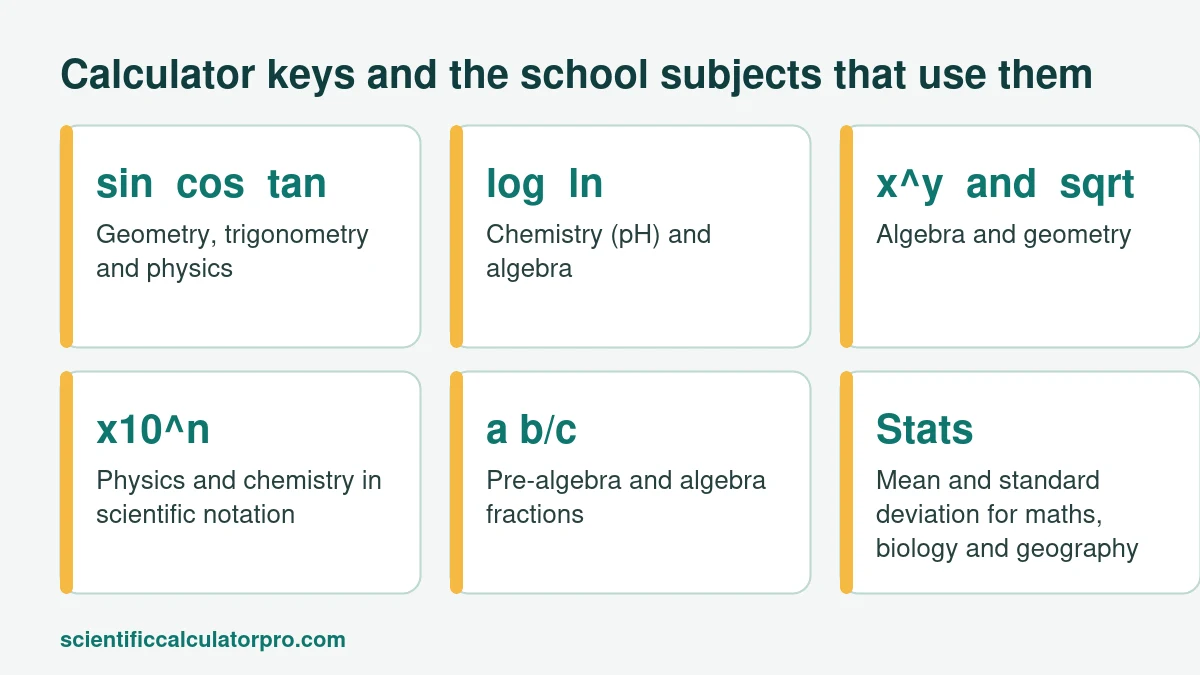
This table shows the keys behind the benefits of a scientific calculator and the classes where they appear.
| Feature | Where you use it | Quick example |
|---|---|---|
| sin, cos, tan | Geometry, trigonometry, physics | Height of a tree: 20 × tan(35°) = 14.0 m |
| log and ln | Algebra, chemistry | pH of a solution with [H+] = 0.001: −log(0.001) = 3 |
| Powers and roots | Algebra, geometry | √152.2756 = 12.34 |
| Scientific notation | Physics, chemistry | 0.5 × 6.022 × 10²³ = 3.011 × 10²³ |
| Fractions | Pre-algebra, algebra | 3/4 + 5/6 = 19/12 |
| Statistics | Maths, biology, geography | Mean, standard deviation, linear regression on many models |
| Memory and history | Any multi-step problem | Store a result, reuse it later |
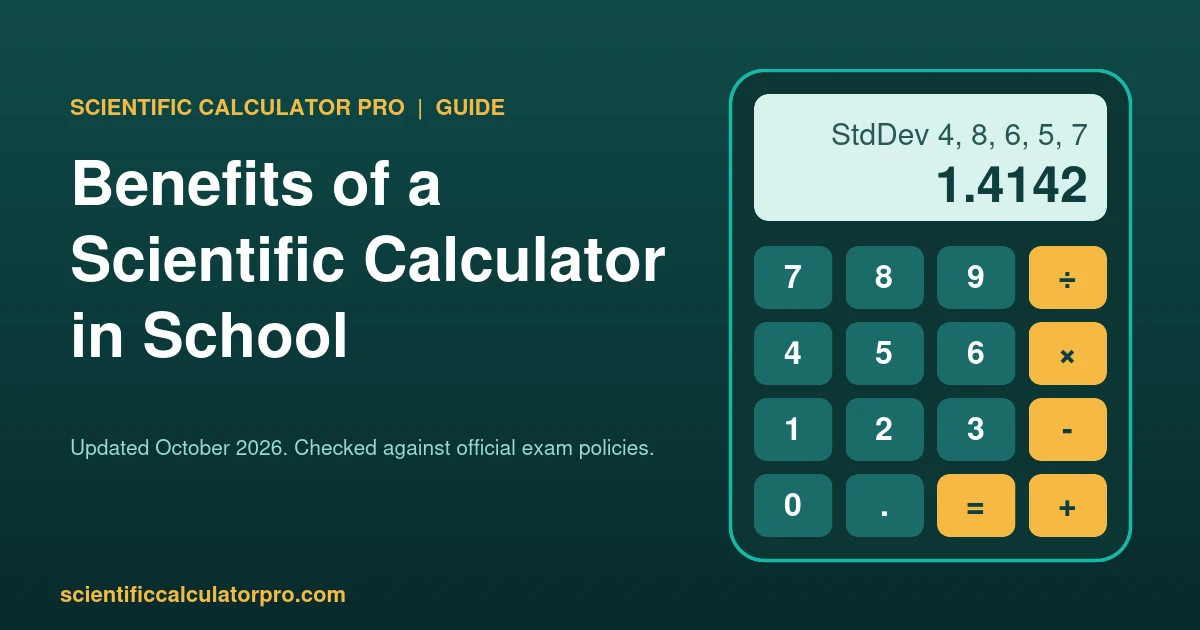
Take the data set 4, 8, 6, 5, 7. The mean is 6. The population standard deviation is 1.414 and the sample standard deviation is 1.581. Calculators give both, usually as σx and sx, and picking the right one is a common exam mark. Our scientific notation calculator and fraction calculator cover two of those rows in more detail.
What Does Research Say About Calculators and Learning?
The fear that calculators weaken basic skills has been tested many times. A widely cited meta-analysis of pre-college studies (Ellington, 2003, in the Journal for Research in Mathematics Education) found that calculators did not harm students’ basic skills, and that students who used them in both lessons and tests did better at operations and problem solving. The lesson is not that more button pressing is better. The benefits of a scientific calculator appear when it sits inside good teaching.
When Can a Scientific Calculator Hurt Learning?
In three situations. The first is early arithmetic, where children still need to build number sense with fractions and times tables. The second is blind pressing, where a student copies a problem into a calculator with a solver and never learns the steps. A calculator will not rescue a weak foundation, and teachers say so for good reason. The third is trusting the screen. A missing bracket or the wrong angle mode gives a confident wrong answer.
The fix is a habit that protects the benefits of a scientific calculator: estimate first, then calculate. For 48 × 52, you can think 50 × 50 = 2500, so an answer near 2500 is sensible. The calculator says 2496, which passes the check. If it said 24,960 you would know a key was misplaced.
Do I Need a Scientific Calculator for My Exam?
The benefits of a scientific calculator on exam day depend on the country and the exam, so read your own rules.
- USA: the SAT and ACT both allow scientific models, and the digital SAT also provides a built-in Desmos calculator. AP exams have their own list.
- South Africa: senior certificate exam circulars have required approved scientific models that are non-programmable and non-graphical, so a basic scientific model is the safe buy. Confirm with your school’s current exam instructions.
- Brazil: ENEM allows no personal calculator, so the benefit there is practice and checking homework, not exam use. Our Portuguese ENEM calculator guide explains the rule.
Is a Free Online Calculator Good Enough for Homework?
Yes. For homework and practice, a free tool gives you the same benefits of a scientific calculator and costs nothing. Our online scientific calculator has trig, logs, memory and a history list. For an exam, bring the physical model your school or test approves, and practise on it ahead of time. Our buying guide compares the common models.
More Guides
- A Beginner’s Guide to Using Your Calculator
- Scientific vs. Graphing Calculators Compared
- Order of Operations on a Calculator: PEMDAS and BEDMAS
- How to Find a Square Root Without a Calculator
- Browse all guides
Sources
Checked October 2026. Worked examples were calculated by hand and verified.
- Ellington, A. J. (2003). A meta-analysis of the effects of calculators on students’ achievement and attitude levels in precollege mathematics classes. Journal for Research in Mathematics Education, 34(5), 433–463.
- College Board: SAT calculator policy
- ACT: calculator policy
- Western Cape Education Department: exam circular on approved calculators (2007)